
Speed First, Cost Second, Clean Third — And Why ESG Still Wins
Feb 27, 2026
The New Energy Calculus
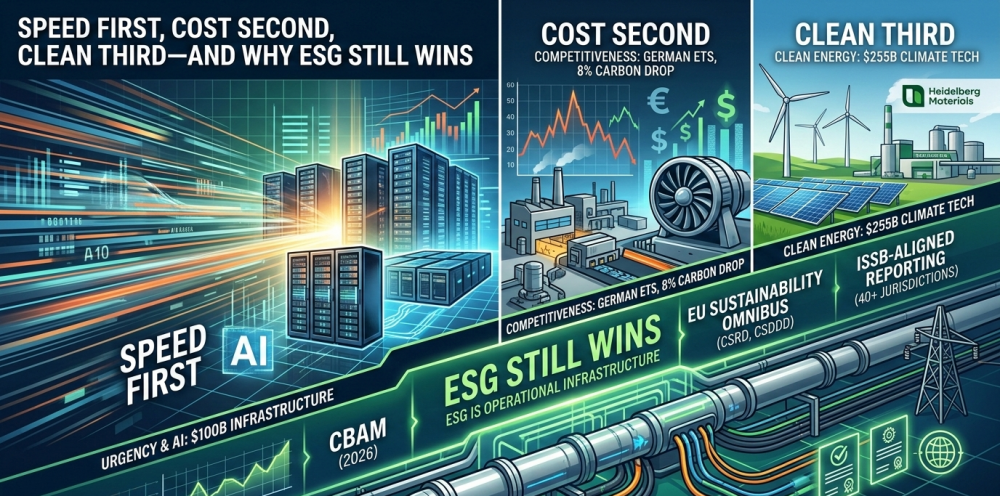
Something fundamental has shifted in the energy investment conversation. For the past five years, clean energy’s selling point was straightforward: it’s better for the planet, and increasingly, it’s cheaper. That narrative drove $255 billion in cumulative climate tech investment by the end of 2025.
Now, a different force is dominating: urgency. AI has created an unprecedented surge in energy demand across advanced economies. OECD energy demand growth hit 2.2% in 2024 — in a region where growth rarely exceeded 1% for three decades. Hyperscalers are spending $50-100 billion annually on infrastructure, and their primary concern isn’t whether the energy is green. It’s whether they can get enough of it fast enough to win the AI race.
The Political Backdrop
This shift is playing out against a politically volatile backdrop. In the United States, the Trump administration has rolled back federal climate policies. In Europe, German Chancellor Friedrich Merz questioned the EU Emissions Trading System at the European Industry Summit in Antwerp on February 12, 2026, calling for a potential overhaul or postponement if the system costs the EU its industrial competitiveness.
Within 24 hours, Merz walked back his comments, calling the ETS a good instrument with positive effects. But the damage was already visible: carbon certificate prices dropped approximately 8% in a single day, and Heidelberg Materials — a company that had positioned itself as a decarbonization leader — saw its stock fall 9.7%.
The political signal is clear: climate policy is being reframed through a competitiveness lens. But the regulatory machinery continues to expand.
The Regulatory Ratchet Keeps Turning
While politicians debate, regulation advances:
- CBAM’s definitive phase began in 2026, with payment obligations starting in 2027. The UK follows with its own carbon border mechanism the same year.
- The EU Sustainability Omnibus was finalized in late 2025, simplifying CSRD and CSDDD but maintaining core obligations for large companies and their supply chains.
- ISSB-aligned mandatory reporting is now being adopted in 40+ jurisdictions covering nearly 60% of global GDP, including China, Hong Kong, Singapore, and Japan from 2026.
- The CSDDD has been operationalized, embedding supply chain human rights and environmental due diligence into EU law.
Why ESG Becomes Operational Infrastructure
This is where the "speed first, cost second, clean third” framing becomes misleading. Yes, the urgent priority for energy buyers is securing supply. But the regulatory requirements for how that supply is documented, traded, and reported haven’t diminished — they’ve intensified.
The result is a new operational reality:
- A MENA aluminium exporter can’t sell into the EU without CBAM-compliant emissions documentation, regardless of how competitive their pricing is.
- A grid equipment manufacturer can’t respond to RFPs from EU utilities without CSRD-aligned supply chain data.
- An energy storage startup can’t close a Series B without demonstrating that their ESG framework meets investor due diligence standards.
ESG hasn’t lost its relevance. It has transformed from a branding exercise into operational infrastructure — the plumbing that enables companies to participate in regulated markets and access institutional capital.
The Strategic Opportunity
For companies positioned at the intersection of energy transition and ESG infrastructure, this moment represents a significant opportunity. The supply-demand imbalance for ESG advisory services in the energy sector is growing:
- Energy consulting is projected to grow from $18.65 billion in 2026 to $29.3 billion by 2034.
- Advisory services represent 41% of the market — the largest segment — driven by demand for strategic guidance on regulatory compliance and energy transition planning.
- Suppliers are "drowning in ESG requests” according to recent industry data, with compliance demands coming in different formats, on different timelines, and for different regulatory purposes.
The companies and advisors that can bridge this gap — combining deep ESG expertise with AI-powered automation and cross-border regulatory knowledge — will capture a disproportionate share of this growing market.
The Bottom Line
The energy world in 2026 runs on a dual operating system: maximum speed for deployment, maximum rigor for compliance. The winners won’t be those who choose one over the other. They’ll be the ones who build the infrastructure to deliver both simultaneously.
Speed first, cost second, clean third? Perhaps. But without the "clean” infrastructure, you don’t get to play the speed game at all.