
Korea's 2028 Sustainability Reporting Mandate: Is Your Company Ready?
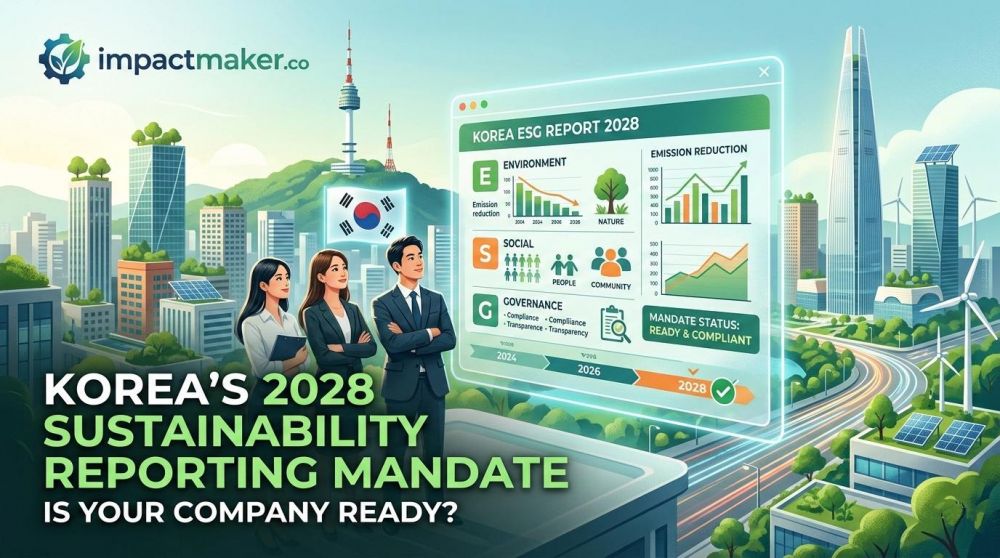
South Korea's Financial Services Commission (FSC) has made it official: Korea sustainability reporting 2028 is no longer a future possibility — it is a regulatory certainty. Starting in 2028, large KOSPI-listed companies will be legally required to disclose their environmental, social, and governance (ESG) performance. By 2030, the mandate expands to every listed company on the exchange.
The question is not whether your company will need to comply. The question is: are you building the foundation today, or will you be scrambling in 2027? This guide breaks down exactly what the mandate requires, why the clock is already ticking, the biggest challenges Korean companies face, and the practical steps you can take right now.
What Is Korea's 2028 Sustainability Reporting Mandate?
The FSC's mandatory ESG disclosure Korea framework is modelled closely on the International Sustainability Standards Board (ISSB) IFRS S1 and S2 standards — now localised as KSSB 1 and KSSB 2. These standards require companies to disclose climate-related risks and opportunities alongside broader sustainability information that is material to investors.
The Phased Rollout
- 2026: Voluntary disclosure actively encouraged. Companies that start now gain a critical head start.
- 2028: Mandatory ESG reporting Korea begins for KOSPI-listed companies with total assets exceeding KRW 30 trillion.
- 2029: Expanded to KOSPI-listed companies with assets above KRW 10 trillion.
- 2030: Full expansion — all KOSPI-listed companies must comply.
One important note for companies concerned about Scope 3 emissions: the FSC has delayed this specific disclosure requirement until 2030, acknowledging the complexity of supply chain data collection. However, as we explain below, that grace period should not be mistaken for permission to wait.
Why Korea Sustainability Reporting 2028 Matters Right Now — Not in 2027
Here is the reality that many compliance teams are missing: the data you will report in 2028 covers 2027. That means your ESG data collection, governance systems, and internal reporting processes must be fully operational before January 1, 2027. That window is shorter than it looks.
The Real Risks of Waiting
- Data gaps: ESG data — especially energy consumption, waste, and water usage — takes 12–24 months to systematically collect and validate.
- Rushed audits: Third-party assurance, while currently voluntary, is expected to become mandatory. Auditors will scrutinise the reliability of your data trail.
- Investor scrutiny: Institutional investors and foreign capital are already demanding ESG transparency. Non-compliance signals governance risk.
- Reputational exposure: Early adopters will benchmark publicly. Companies that lag behind will stand out — not favourably.
The 4 Biggest Challenges Korean Companies Face Today
Challenge 1: Framework Confusion
Most Korean companies are unsure which standard applies to them. Should they follow KSSB, GRI, ISSB, or TCFD? The answer depends on your company's size, sector, and whether you have international investors or supply chain partners — but without expert guidance, many organisations spend months going in circles.
Challenge 2: No ESG Data Infrastructure
Most companies do not have the systems in place to collect, store, and validate ESG metrics across business units. Finance teams are often pulling data from disconnected spreadsheets, and sustainability data is rarely auditable in its current form.
Challenge 3: Lack of Internal Expertise
Sustainability reporting requires a rare combination of skills: regulatory knowledge, financial materiality assessment, stakeholder communication, and data analysis. Most Korean companies do not yet have a dedicated sustainability team — and building one from scratch takes time that many organisations do not have.
Challenge 4: Disconnected Stakeholders
ESG reporting touches finance, legal, operations, procurement, and communications — but these teams rarely work together in a coordinated way. Without a cross-functional framework, critical data is missed and disclosures become inconsistent.
How to Prepare: A 5-Step ESG Readiness Roadmap
The good news: companies that start structured preparation now have more than enough time to achieve full compliance with confidence. Here is where to begin.
Step 1: Conduct a Materiality Assessment
Identify which ESG topics are most relevant to your business, your investors, and your stakeholders. This forms the foundation of everything else — it determines what you disclose and how you prioritise resources.
Step 2: Align on Your Reporting Framework
Determine whether KSSB 1 & 2 (ISSB-aligned) is your primary framework, and whether you need to layer on GRI for broader stakeholder disclosure. This decision shapes your entire reporting architecture.
Step 3: Build Your ESG Data Collection Systems
Identify your key metrics, assign data owners across the organisation, and implement systems to collect, store, and verify data consistently. This is the most time-intensive step — start it first.
Step 4: Engage Internal Stakeholders
Sustainability reporting cannot be owned by one person or department. Engage finance, legal, operations, and executive leadership early. Set clear roles, responsibilities, and timelines.
Step 5: Partner with an Expert to Close the Gaps
Even companies with internal sustainability teams benefit from external expertise. An experienced partner can conduct a gap assessment, benchmark your performance against peers, and ensure your disclosures meet mandatory ESG disclosure Korea standards — so you report with confidence, not guesswork.
How ImpactMaker Can Help
At ImpactMaker.co, we work with Korean companies and multinationals operating in Korea to navigate the full ESG reporting journey — from first-time readiness assessments to publication-ready sustainability reports.
Our services include:
- ESG Gap Assessments — understand exactly where you stand against KSSB and ISSB requirements
- Sustainability Report Writing & Strategy — structured, investor-grade disclosures
- Framework Alignment Consulting — KSSB, GRI, ISSB, and TCFD navigation
- Third-Party Assurance Readiness — preparing your data and processes for independent verification
We combine deep knowledge of global ESG frameworks with practical, on-the-ground experience in the South Korean regulatory environment. Whether you are a KOSPI large-cap beginning your compliance journey or an SME planning ahead for 2030, we provide the clarity and structure you need.
The Bottom Line: 2028 Is Closer Than It Feels
Korea's sustainability reporting mandate is not a distant regulatory event — it is a near-term business reality with preparation timelines that start today. The companies that build robust ESG foundations now will enter 2028 with investor confidence, operational clarity, and a competitive edge. Those that wait will face data gaps, audit pressure, and reputational risk under the full glare of mandatory public disclosure.
The leaders of tomorrow's Korean market are making ESG decisions today. The question is which side of that divide your company will be on.