
What the EU Taxonomy Omnibus Amendments Mean for Bank GAR Reporting in 2026
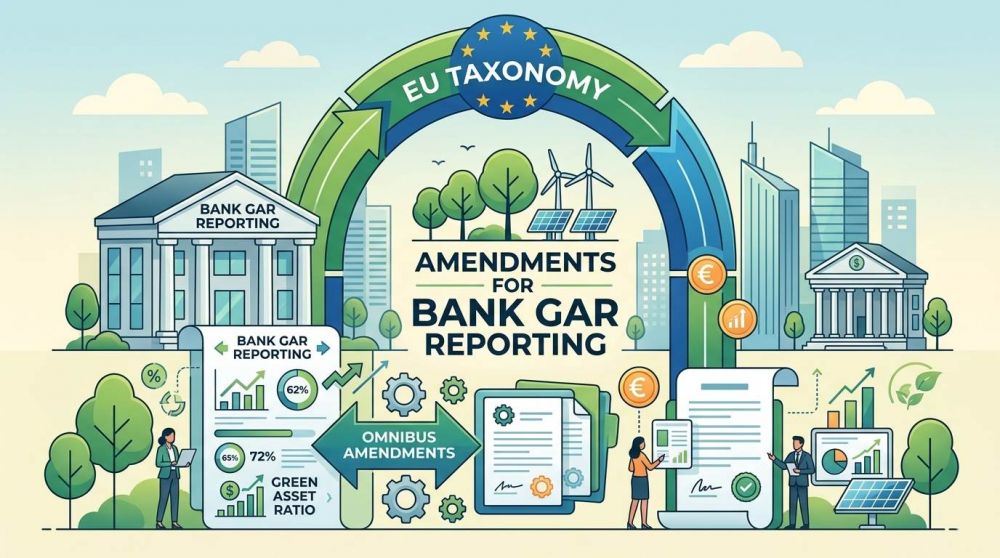
The Regulatory Ground Has Shifted
When the EU Taxonomy Regulation was first introduced, it set a clear ambition: create a common language for sustainable finance. For banks, this translated into one headline metric — the Green Asset Ratio (GAR) — a figure that investors, regulators, and analysts would use to assess how much of a bank’s balance sheet supports environmentally sustainable activities.
But the framework has never been static. Delegated Acts, Q&As, and FAQs have evolved continuously. And in 2024–2025, the European Commission introduced the Omnibus Package — a set of amendments that represent the most significant revision to Taxonomy reporting requirements since the original regulation was published.
For banks, these amendments are not simply a compliance update. They are an opportunity — one that most institutions have not yet fully acted on.
What the Omnibus Amendments Actually Changed
Understanding the Omnibus amendments requires cutting through a significant volume of regulatory language. Here is what matters most for bank Taxonomy reporting:
1. Adjusted Scope Definitions
The amended regulation introduces more precise scope boundaries for which assets must be included in Taxonomy KPI calculations. Certain exposures that previously required complex data collection can now be treated under simplified rules, and some categories are expressly excluded from mandatory reporting scope.
In practice, this means that many banks have been applying a more burdensome scope than the amended regulation requires. Re-mapping your current portfolio against the updated scope boundaries is often the fastest route to reducing reporting effort — and, in some cases, improving reported KPIs by removing categories that were dragging down the ratio.
2. New Materiality Thresholds
The Omnibus amendments introduced materiality thresholds that allow banks to deprioritise certain counterparty segments and exposure types. Rather than requiring granular Taxonomy assessment across every single exposure, the new rules create proportionality mechanisms that align assessment effort with economic significance.
Applying these thresholds strategically — identifying which parts of the portfolio fall below materiality and can be treated under simplified approaches — is one of the most significant operational simplification opportunities available to banks today.
3. Voluntary Inclusion Options
Perhaps the most underutilised change in the Omnibus package is the introduction of voluntary inclusion provisions. These allow banks to include certain asset types and counterparty exposures that were previously excluded from Taxonomy KPI calculations.
For banks with large mortgage books, green SME lending programmes, or significant retail portfolios, voluntary inclusion can materially improve reported Taxonomy alignment — provided the bank can demonstrate the necessary evidence of alignment.
4. Revised Reporting Templates
The amended regulation includes updated reporting templates with modified column structures, revised definitions, and new disclosure fields. Banks that have not yet updated their reporting setup to reflect the new templates may be disclosing on an outdated basis — creating inconsistency risk with regulatory expectations.
Why Most Banks Are Leaving GAR Points Unreported
There is a persistent misconception in the market: that low Taxonomy KPIs reflect low green lending. In our experience working across multiple European banking institutions, this is rarely the case.
The more common explanation is one of three fixable problems:
- Data gaps: Banks often cannot evidence alignment for activities that are genuinely green. Counterparties do not provide the necessary documentation. Internal systems were not designed to capture Taxonomy-relevant data. The result is that lending which could qualify for Taxonomy alignment is reported as non-eligible or non-aligned by default.
- Methodology choices: Early-stage reporting decisions — many made before the regulatory framework was fully settled — baked in conservative interpretations that the current framework no longer requires. These choices persist because no one has had time to revisit them.
- Untapped regulatory flexibility: The Omnibus amendments created new options that most banks have not yet modelled. The difference between a bank that has applied voluntary inclusion options and one that has not can be significant in GAR terms — without any change in the underlying lending book.
The diagnostic question is not ‘are we doing enough green lending?’ It is ‘are we correctly evidencing and disclosing the green lending we are already doing?’
What Peer Banks Are Doing Differently
Peer benchmarking across institutions with similar loan portfolios reveals meaningful variation in GAR outcomes that cannot be explained by lending activity alone. Banks with stronger KPIs typically share several characteristics:
- They have structured counterparty data collection programmes that systematically gather Taxonomy-relevant information from corporate borrowers.
- They apply materiality thresholds strategically, focusing assessment effort on high-impact exposures rather than spreading resources thinly across the full portfolio.
- They use voluntary inclusion options to capture green retail lending and mortgage portfolios that might otherwise fall outside mandatory scope.
- They have invested in internal process automation to reduce the manual effort required for Taxonomy assessment, freeing up capacity for higher-value interpretation work.
- They revisit methodology decisions annually rather than treating the initial reporting setup as permanent.
None of these practices require a complete reporting overhaul. They are incremental improvements, applied systematically.
A Diagnostic Framework for Banks
Given the complexity of the amended framework, we recommend a structured diagnostics approach before making any reporting changes. The goal is to identify the highest-impact opportunities specific to your portfolio and reporting setup, rather than applying generic recommendations that may not be relevant.
Step 1: Regulatory Change Mapping
Translate the Omnibus amendments into concrete implications for your specific reporting setup. Which changes affect your current approach? Which create opportunities? Which require action before your next disclosure cycle?
Step 2: KPI Impact Analysis
Model the potential impact of regulatory changes on your GAR and other Taxonomy KPIs. What is the realistic uplift available from scope adjustments, materiality thresholds, and voluntary inclusion? What evidence would be required to capture it?
Step 3: Peer Benchmarking
Compare your reporting approach and KPI outcomes with institutions that have similar portfolio profiles. Where are the gaps? What are comparable banks doing that you are not? What practices are delivering the strongest results?
Step 4: Opportunity Prioritisation
Not all improvement opportunities are equal. Some require significant counterparty engagement. Others can be applied immediately within existing data sets. A structured prioritisation — weighted by impact, effort, and risk — ensures resources are directed toward the highest-value actions.
Step 5: Actionable Roadmap
Translate the diagnostics findings into a clear, sequenced action plan. What changes should be made before the next disclosure? What longer-term capability investments are warranted? Who needs to be involved internally?
The Strategic Opportunity
EU Taxonomy reporting is moving from a compliance exercise to a strategic asset. Investors increasingly use GAR as a proxy for a bank’s green finance capability. Regulators are developing supervisory expectations around Taxonomy methodology. Capital markets are linking green financing terms to Taxonomy alignment.
Banks that improve their GAR through better evidencing, smarter methodology, and strategic use of regulatory flexibility will be better positioned — with investors, with regulators, and in the market for sustainable finance.
The Omnibus amendments created new room to manoeuvre. The question is whether your institution is using it.