
How to Benchmark Your Reputation Against Competitors
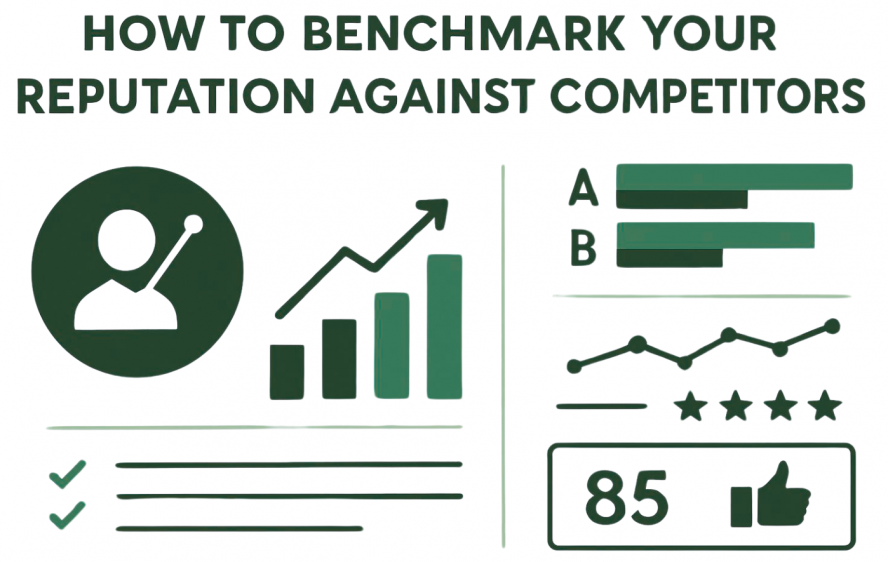
Your brand's online reputation is not judged in isolation — it is always measured against someone else. Here is how to make that comparison structured, scored, and strategically useful.
Most businesses know they have an online reputation problem only after they've already lost something- a client, a hire, an investor conversation that went cold. By then, the damage is visible in search results, review platforms, and AI-generated brand summaries that no one thought to audit before they mattered.
What fewer businesses know is that their online reputation exists on a relative scale. When a prospective customer searches your category, they are not evaluating you in a vacuum. They are comparing your star ratings to the competitor one column over. They are noticing that your LinkedIn presence is sparse while a rival's is authoritative. They are reading what ChatGPT says about your firm versus what it says about theirs.
Reputation benchmarking is the practice of measuring your digital standing against direct competitors — across search results, review platforms, AI search engines, social channels, and public sentiment — to identify where you are winning trust and where you are quietly losing it. Done properly, it turns a vague reputational anxiety into a set of specific, prioritised gaps with a clear intervention path for each.
This article walks through how to conduct that benchmarking exercise from first principles, what to measure, and how to translate the findings into an ORM strategy that closes the gap.
"Your reputation is not a fixed asset. It is a live score — refreshed constantly by search engines, review platforms, and now AI tools. The question is not whether it is being measured. It is whether you are measuring it first."
Why Most Companies Skip Benchmarking — and Pay for It Later
Online reputation management is often treated as a reactive discipline: something you engage when there is a crisis, a flood of negative reviews, or a damaging article ranking on page one. The investment in proactive measurement rarely feels urgent — until a competitor with a cleaner digital presence is consistently winning the business you should have closed.
The reason benchmarking gets skipped is structural. Reputation feels qualitative. It seems difficult to score. And because the consequences of a weak digital presence compound slowly — eroded over months of missed first impressions — there is rarely a single moment that forces the issue.
But the cost is real and measurable. Review scores influence purchasing decisions across professional services, e-commerce, and hospitality. SERP rankings for branded terms determine whether the first thing a prospect sees is your controlled narrative or someone else's critique. AI tools like ChatGPT, Gemini, and Perplexity are now generating brand descriptions from uncurated sources — meaning a competitor with better-managed content assets is getting a better AI-generated biography, regardless of actual business quality.
Risk Blind Spot
Many companies assume that if they are not receiving complaints, their reputation is healthy. In practice, silence is often a measurement failure. Negative content accumulates in places no one is watching — niche review sites, third-party listings, AI training sources — and compounds before it surfaces as a business problem.
The Five Dimensions of a Reputation Benchmark
A credible competitive reputation audit covers five distinct layers. Each tells a different part of the story. Omitting any one of them creates a blind spot that distorts the conclusions.
Search Result Positioning: What appears on pages one and two when someone searches your brand — and how it compares to what appears for your competitors' brands.
Review Platform Performance: Average ratings, review volume, recency, and response quality across Google, Trustpilot, Glassdoor, Yelp, and sector-specific platforms.
AI Search Visibility: How AI tools describe your brand in response to relevant queries — and whether that description is accurate, neutral, or subtly negative.
Brand Sentiment & Mentions: The volume, source, and tone of brand mentions across social channels, news outlets, forums, and industry publications.
Owned Asset Authority: The strength, consistency, and reach of your owned digital presence — website, social profiles, thought leadership content, and leadership bios.
Step One: Define Your Comparison Set
Benchmarking requires a defined peer group. This sounds obvious, but the choice of comparators fundamentally shapes the value of the exercise. Compare against companies that are too large or well-resourced, and the gap analysis becomes demoralising rather than strategic. Compare against companies that are too similar in size and obscurity, and you learn nothing about what a strong reputation actually looks like in your category.
A well-chosen benchmark set typically includes three to five competitors: two or three direct competitors at a similar commercial scale, one aspirational player whose reputation performance you want to close the gap on, and one company outside your immediate competitive set that is known for exceptional digital reputation management in an adjacent sector.
For each comparator, you need to establish their primary branded search terms, the review platforms where they are most active, their key leadership names (for personal brand assessment), and any known reputation events — crises, award wins, or notable coverage — that may distort a point-in-time reading.
Step Two: Run Your SERP Audit
For each company in the comparison set — including your own — conduct a structured search result audit across your five most important branded and category search terms. These should include the core brand name, the brand name plus sector descriptor, the brand name plus "reviews", the CEO or founder's name, and one or two product or service terms unique to your category.
For each search, document the first ten results: the type of content (owned website, review platform, news article, social profile, third-party listing, competitor mention), the sentiment (positive, neutral, or negative), and the domain authority of the source. This gives you a content composition score for each search term — and, more importantly, lets you compare compositions side by side.
Diagnostic Example
A mid-size legal advisory firm searches their brand name alongside two competitors. Their own results: page one contains their website, a Trustpilot listing with 3.2 stars, one dated news article about a regulatory inquiry three years prior, and a legal directory entry with incomplete information.
Competitor A's results: their website, a Chambers ranking, three positive industry features, a LinkedIn company page, and a 4.6-star Google rating with 180 reviews. The reputational disparity is visible without any further analysis.
Step Three: Score Your Review Platform Performance
Review platforms are often where the most immediately visible reputation gaps live. They are also the most directly actionable — a structured review management programme can move average ratings and volume metrics within months, producing measurable improvement that is visible to every prospect who searches.
For your benchmark, extract the following data points for each company across the platforms relevant to your sector. At minimum, this means Google Business Profile, Trustpilot, and Glassdoor. Depending on industry, it may also include Yelp, G2, Clutch, Capterra, TripAdvisor, or healthcare and legal directories.
A gap analysis table like this, completed with real data, immediately surfaces where the most pressing interventions are needed. In most cases, low review volume is the primary issue — not necessarily poor service quality. Companies with excellent client relationships but no structured review-generation programme consistently underperform competitors who actively ask satisfied customers to share their experience.
Step Four: Audit AI Search Visibility
This dimension of the benchmark is new enough that most ORM programmes have not yet incorporated it — which means it is also one of the areas where early movers can gain a meaningful advantage.
AI tools including ChatGPT, Gemini, Perplexity, and Microsoft Copilot are now generating brand descriptions in response to queries like "who are the leading firms in [sector]", "what do clients say about [company name]", and "compare [brand A] with [brand B]". These descriptions are synthesised from sources across the web — review platforms, news articles, social profiles, Wikipedia entries, and structured data — without human curation or any mechanism for the brand to respond.
For the benchmark, run each company name and category query through at least two major AI tools and record what is generated. Note whether the brand appears at all, how it is characterised, whether any negative context is surfaced, and whether competitors with stronger content assets receive more favourable or more detailed descriptions.
"A competitor with a well-maintained Wikipedia entry, active thought leadership content, and strong review platform presence will receive a better AI-generated description than a company with superior service quality but weaker digital assets. The algorithm does not know the difference."
Improving AI search visibility requires a different set of interventions than traditional SERP management: publishing authoritative long-form content, building entity associations through structured data, and ensuring that the sources AI tools rely on most — Wikipedia, Wikidata, major publications, and high-authority review platforms — reflect accurate, positive brand information.
Step Five: Assess Brand Sentiment and Mention Quality
Beyond review platforms and search results, brand sentiment flows through social media threads, industry forums, Reddit discussions, LinkedIn commentary, and news publications. This layer of the benchmark is harder to quantify but often carries disproportionate influence — particularly for B2B buyers who conduct deep due diligence before committing to a vendor relationship.
For each company in the comparison set, a sentiment audit should identify the volume of brand mentions over the past twelve months, the ratio of positive to negative to neutral mentions, the most prominent sources driving each sentiment tier, and any recurring themes in negative commentary that represent a systemic reputation risk rather than isolated complaints.
Tools such as Brandwatch, Mention, or Talkwalker can automate much of this data collection, but the analysis- interpreting what themes indicate, what risks they represent, and which interventions will move the sentiment score- requires structured human judgement. The benchmark is not simply a data extraction exercise. It is a diagnostic that translates data into priorities.
Step Six: Evaluate Owned Digital Asset Authority
The final dimension of the benchmark examines the quality, consistency, and authority of each company's owned digital presence. This includes the website, social profiles, executive bios, LinkedIn company page, YouTube channel, and any thought leadership content published under the brand or its principals.
Owned assets matter in the benchmark for two reasons. First, they are the primary mechanism through which a company controls its narrative- displacing negative search results requires positive, authoritative owned content to fill the gap. Second, they signal credibility to both human audiences and AI systems: a company with a well-maintained website, consistent social presence, and regular thought leadership publication is algorithmically favoured over one with sparse or outdated owned assets.
- Website content freshness and authority
- LinkedIn company page completeness and activity
- Executive and founder personal brand presence
- Thought leadership and media coverage volume
- Structured data and entity completeness
Translating the Benchmark Into a Prioritised ORM Strategy
The benchmark exercise produces a multi-dimensional picture of where your reputation stands relative to competitors. The next step — and the one most often handled inadequately — is translating that picture into a prioritised action plan where the highest-impact interventions are sequenced first.
Prioritisation should be driven by two factors: the severity of the gap (how far behind the competitive benchmark you are on each dimension) and the speed at which an intervention can close it. Review volume, for example, can improve significantly within sixty to ninety days with a structured outreach programme. AI search visibility, by contrast, responds over a longer timeframe as content and entity signals accumulate. Negative content removal through GDPR right-to-erasure requests or DMCA takedowns operates on a different timeline again, depending on the platform and the legal basis.
Prioritisation Framework
Immediate (0–60 days): Review generation programme, review response protocols, Google Business Profile optimisation, claiming and completing unclaimed platform profiles.
Short-term (60–120 days): SERP content suppression strategy, negative content removal submissions, owned content creation targeting high-priority branded keywords.
Medium-term (3–6 months): Thought leadership publication, executive personal brand build, AI search entity optimisation, brand mention monitoring activation.
Ongoing: Real-time monitoring, monthly reputation scoring, quarterly benchmark refresh, crisis response playbook maintenance.
How Often Should You Re-Run the Benchmark?
Reputation is not static. Competitors invest in ORM, generate new content, launch review programmes, and respond to their own crises — all of which shifts the relative benchmark. A quarterly refresh of the key data points is generally sufficient for most organisations, with a full diagnostic re-run every six to twelve months.
What should not wait for the quarterly review is the monitoring layer. Real-time brand mention and sentiment tracking needs to be active continuously — not because every mention requires a response, but because emerging threats compound fastest in the first 24 to 72 hours. A single critical article or coordinated negative review campaign can move your SERP position and review scores significantly within days. Catching it early is the difference between suppression and crisis management.
What the Benchmark Reveals That Intuition Cannot
Most executives have a general sense of their company's reputation — shaped by client feedback, personal searches, and informal awareness of how the company is perceived in market. What the structured benchmark reveals is almost always more specific, more actionable, and more concerning in particular dimensions than intuition suggested.
Common discoveries include: a competitor with a lower-quality service product that consistently outperforms on review scores simply because they ask for reviews systematically. An AI-generated brand description that surfaced a regulatory issue from four years ago- correctly attributed without any positive context to balance it. A Glassdoor profile that is silently damaging talent acquisition by making the company look like a difficult place to work, based on three negative reviews that were never responded to. An executive whose Google results surface a personal controversy that now appears above the company website in a branded search.
None of these are surprises that intuition could have anticipated. All of them are immediately visible in a structured benchmark. And all of them are addressable - with the right diagnostics-led approach, the right prioritisation, and the right execution sequencing.
Running This Benchmark Effectively Requires More Than a Checklist
The framework above is a starting point. Executing it with enough rigour to produce genuinely actionable findings — and then translating those findings into a sequenced, scored ORM roadmap — requires diagnostic expertise, access to the right monitoring and intelligence tools, and the strategic judgement to separate what is urgent from what is merely visible.
Impact Maker's Online Reputation Management Diagnostics service is built around exactly this process: a structured, five-phase audit that establishes a scored reputation baseline, maps all content threats, benchmarks your position against three direct competitors, and delivers a prioritised ORM roadmap in an executive strategy session. It is the starting point for every client who wants to move from passive exposure to active reputation management with a clear picture of what needs to change and why.
Get your reputation benchmark done right
Impact Maker's ORM Diagnostics service delivers a scored baseline, full SERP audit, competitor benchmark across three comparators, AI search visibility scan, and a prioritised ORM roadmap. Schedule a Free Call