
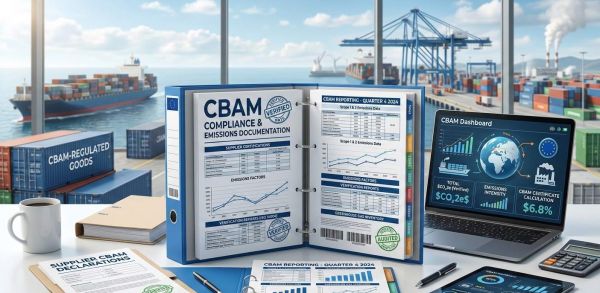
Cbam Compliance & Emissions Documentation

About The Service
Other Information
Customer Challenge
CBAM entered its definitive phase in January 2026. From February 2027, EU importers must surrender CBAM certificates proportional to the embedded carbon emissions of covered goods imported from non-EU countries. The EU ETS carbon price directly determines the cost of those certificates.
Exporters of covered goods — steel and iron, aluminium, cement, fertilisers, hydrogen, and electricity — now face a binary commercial situation: either provide verified actual embedded emissions data, or have their EU importers pay certificate costs based on EU default values, which are typically higher than actual production emissions and result in higher costs. From July 2024, using default values is already restricted to 20% of total reported emissions for complex goods. From 2026, full reliance on defaults is not available.
Many exporters in LATAM, MENA, and Asia have not yet calculated their actual embedded emissions using EU methodology, do not have CBAM-compliant documentation, and are uncertain whether their EU importers understand what data is required from them. This creates commercial risk — EU importers facing CBAM compliance liability may seek alternative suppliers who can provide verified emissions data.
Service Solution
Our project leads work with your production team to calculate embedded emissions per product line using the EU's specified methodology under Commission Implementing Regulation (EU) 2023/956 and its implementing rules. We produce the specific data formats EU importers require, provide a cost comparison showing your verified emissions versus applicable default values, and prepare a cost projection for your EU buyers. For clients interested in emissions reduction, we produce a prioritised decarbonisation roadmap connected directly to CBAM cost savings.
We work with exporters in LATAM, MENA, and Asia who export to the EU, as well as with EU importers who need to support their suppliers through the verification process.
Service Activities
Scope Confirmation and CBAM Classification
- Confirmation of which of your products are covered under CBAM regulation
- HS code classification of covered goods
- Determination of applicable direct and indirect emission calculation requirements
Embedded Emissions Calculation
- Direct emissions: combustion, process emissions, and fugitive emissions per installation
- Indirect emissions (where required): purchased electricity emissions per product
- Calculation using EU-accepted methodology — activity-based where data is available
- Documentation of emission factors, data sources, and assumptions per the EU implementing rules
Default Value Comparison
- Calculation of what your product would attract under EU published default values
- Cost comparison: your actual verified emissions vs. EU defaults at current ETS prices
- Quantification of the cost difference — presented in a format usable by your EU importers
CBAM Documentation Package
- Embedded emissions data in the structure required by EU importers for CBAM reporting
- Documentation of calculation methodology and data sources to the standard required for EU authority verification
- Summary document for direct use by your EU importer in their CBAM declaration
Carbon Cost Projection
- CBAM certificate cost projection per product line at current EU ETS price and two scenario prices
- Multi-year projection illustrating how costs change as ETS prices evolve
- Applicable carbon price deduction assessment (for exporters in countries with domestic carbon pricing)
Expert Consultation
- Minimum one 90-minute session to review findings, explain the documentation to your team, and advise on EU importer communication
Key Results
Verified Emissions Documentation: CBAM-compliant embedded emissions data ready for use by your EU importers
Cost Clarity: Quantified difference between your verified emissions and EU default values — expressed in euros per tonne and per shipment
Commercial Preparation: Documentation your EU importers need to manage their CBAM obligations, reducing the risk that they seek alternative suppliers
Deduction Analysis: Identification of any domestic carbon pricing credits applicable to your exports under CBAM rules
Calculation Record: Documented methodology that can be submitted to EU competent authorities if your importer's CBAM declaration is queriedCustomer Value
Protect EU Market Access: EU importers facing CBAM liability increasingly prefer suppliers who can provide verified emissions data — this service provides that documentation
Quantify Your Carbon Position: Understand the actual cost of your embedded emissions under CBAM pricing before your importers absorb it as a problem
Support Your EU Importers: CBAM compliance is your importer's legal obligation — but providing verified emissions data reduces their cost and administrative burden, strengthening the commercial relationship
Foundation for Reduction: The emissions calculation is the starting point for any decarbonisation plan connected to CBAM cost reduction
Defensible Record: Documented calculations and methodology that withstand EU authority scrutinyIndustries covered by service
Industry Coverage Information
Delivery Model
Delivery Setup
Client responsibilities
- Discovery call (60 min) — product lines, production volumes, and EU export volumes confirmed
- Production data access — energy consumption, fuel use, process input quantities, and production output data per installation
- Electricity data — source, volume, and emission factor for purchased electricity where applicable
- Identify production contact — the internal person with access to operational data
- Existing environmental data — any prior carbon calculations, environmental permits, or emission factor records
- EU importer contact — we recommend looping in your EU importer to confirm the documentation format they require
- Review draft documentation — timely feedback within the agreed revision window
Delivery Region Scope
Delivery Language
Service Outline
Regulatory Context
CBAM was designed to prevent carbon leakage- the movement of production to non-EU countries with lower carbon costs. Under the definitive phase, EU importers must declare the embedded carbon emissions of covered goods and surrender CBAM certificates proportional to those emissions. The certificate price tracks the EU Emissions Trading System (ETS) price.
Exporters have two options: provide verified actual emissions data (resulting in certificate costs based on real production efficiency) or rely on EU default values (set at the 90th percentile of EU production -a deliberately conservative benchmark). The default value approach results in higher certificate costs for most non-EU producers and is restricted in its application from 2024 onward.
The calculation methodology is defined in EU implementing regulations. Embedded emissions include direct process and combustion emissions per product installation, and indirect electricity emissions where applicable. The data and methodology must be documented to the standard required for EU authority verification.
Our Approach
We work from your actual production data - energy inputs, process parameters, and output volumes - to calculate embedded emissions per tonne of product using EU-specified methodology. We document every calculation step, data source, and emission factor to create a traceable record. We then produce the data summary in the format your EU importer needs for their CBAM declaration.
We also quantify the cost difference between your verified emissions and the EU default values at current ETS pricing, so you have a clear commercial case for the data collection investment.
The engagement does not require on-site visits in most cases - production data can typically be provided remotely. Where on-site data collection is needed, this is scoped separately.
What's Included — All Packages
All engagements include:
- Lead CBAM methodology specialist as primary contact
- Embedded emissions calculation per agreed product scope
- CBAM documentation package for EU importer use
- Default value comparison and cost projection
- Expert consultation session
- Email support throughout engagement
Available Add-Ons
- On-site production data collection support - €3,500 + travel
- Additional product lines beyond package scope - €2,200 per product line
- EU importer briefing call (beyond included sessions) - €350/hour
- CBAM documentation in German or French — €950 per language
Prerequisites for Successful Engagement
- Production data available - energy, fuel, process inputs, and output volumes per product per installation
- Production contact - an internal person with access to operational and energy data
- HS code clarity - ability to confirm product classification (or confirmation that this is part of scope)
- EU importer communication - willingness to loop EU importers into documentation process
- Realistic data quality expectations - calculations are only as accurate as the production data provided; data quality limitations will be documented
- Timeline awareness - the definitive CBAM phase is live; EU importers will require verified data from exporters ahead of their own reporting deadlines
Frequently Asked Questions
Q: Our EU importer is asking for CBAM documentation - what exactly do they need?
Answer: Your EU importer needs your product's embedded emissions expressed in tCO2e per tonne of product, calculated using EU methodology, with the supporting data and calculation record. The Discover package produces exactly this.
Q: What happens if we rely on EU default values instead?
Answer: Your EU importer pays CBAM certificate costs based on default values, which are set at the 90th percentile of EU production emissions - typically higher than actual production emissions. Additionally, from 2024, default values are restricted to 20% of total reported emissions for complex goods, which limits how long a default value strategy remains viable.
Q: Can our EU importer use your documentation directly for their CBAM declaration?
Answer: Yes. The documentation is structured for direct use by the EU importer in their CBAM declaration submission. We recommend confirming the format with your specific importer, which we can help with.
Q: Does this service include applying for CBAM certificates?
Answer: No. CBAM certificate purchase is the legal obligation of the EU importer, not the exporter. This service produces the emissions data that enables the importer to calculate and purchase the correct number of certificates.
Q: We have never calculated our carbon emissions - can we still use this service?
Answer: Yes. We work from your production data, not from prior carbon calculations. You do not need an existing carbon footprint assessment. We calculate from first principles using EU methodology.
Q: What if our production data is incomplete?
Answer: We document data gaps and apply conservative estimates or EU default values for missing data points, clearly noting this in the calculation record. Incomplete data reduces the precision of the calculation and may affect how your importer chooses to use the documentation.
Getting Started
Step 1: Contact us at sales@impactmaker.co or complete the CBAM pre-proposal questionnaire
Step 2: Discovery call (60 min) - confirm product scope, production data availability, and EU export volumes
Step 3: Proposal delivery (3-5 business days) - confirmed scope, timeline, and investment
Step 4: Kick-off within 1 week of contract signature
Impact Maker
www.impactmaker.co | sales@impactmaker.co
Embedded emissions calculation and CBAM documentation for exporters of covered goods to the EU
Categories
Expertise
€13,330.00
Ideal For: Exporters with a single primary covered product seeking to establish their CBAM position and produce initial importer documentation
- Discovery call (60 min) — product scope, production data availability, EU export volumes
€24,940.00
Ideal For: Exporters with multiple covered products, high EU export volumes, or significant CBAM cost exposure
- Everything in DISCOVER, plus:
€33,540.00
Ideal For: Large-volume exporters, multi-site producers, or companies needing annual CBAM documentation as a recurring service
- Everything in REALIZE, plus: