
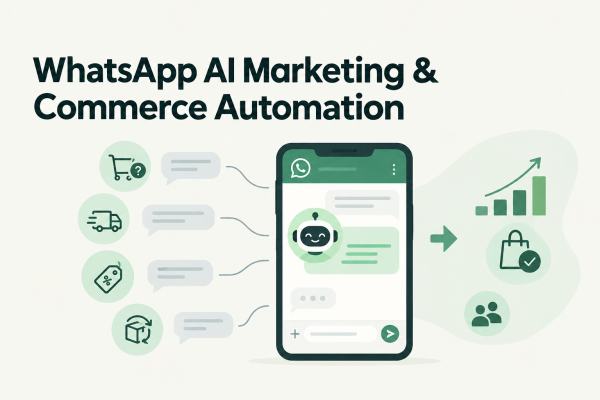
WhatsApp AI Marketing & Commerce Automation

About The Service
Other Information
Customer Challenge
- Ticket flood on repetitive questions. 30–50% of e-commerce support tickets are simply "where is my order?", each costing an agent 5–15 minutes of manual lookup across systems.
- Revenue lost outside business hours. Product questions arrive at 22:00 and go unanswered until morning. The customer has already bought elsewhere.
- Cart abandonment email cannot fix. Around 70% of carts are abandoned. Email recovers 2–5%, because the reminder lands hours later in a crowded inbox after intent has faded.
- A decaying primary channel. Email open rates sit at 20–40% and continue to fall, while acquisition costs rise and the same audience has to be re-bought through ads.
- Manual returns and cancellations. Each return takes 10–20 minutes across multiple systems. Cancellations that arrive after the warehouse has shipped turn into expensive two-way returns.
- Headcount pressure. Conversation volume grows every quarter. The support budget does not.
Service Solution
Five Core Capabilities
1. AI Resolution Agent Multilingual intent recognition across WhatsApp, email, Instagram, Facebook and web chat. Answers grounded in your real order and product data rather than generic model output. Sub-10-second responses. Automatic escalation to a human with the full conversation attached whenever the request is sensitive, ambiguous or high-value.
2. Commerce & ERP Data Layer Native connections to Shopify, WooCommerce, Xentral, JTL and Billbee. Order lookup by email, order number or phone. Live carrier tracking retrieval. Invoice PDF retrieval direct from the ERP. Return creation and carrier label generation written back into your systems.
3. Consent & Opt-In Infrastructure Timestamped double opt-in capture through website pop-ups, QR codes, checkout consent, thank-you page widgets and click-to-WhatsApp links. Records are exportable and yours. Compliant with both GDPR and Meta's own platform policy — the two things that get accounts suspended.
4. Revenue Flow Automation Abandoned cart recovery triggered 30–60 minutes after checkout drop-off. Three-stage post-purchase journey covering confirmation, tracking, review request and cross-sell. Segmented campaigns built from your store data. VIP early access driven by lifetime value. Klaviyo coordination so no customer receives the same message twice on two channels.
5. Deliverability & Compliance Guardrails Continuous quality-rating monitoring, managed progression through Meta's messaging tiers, template approval handling, and pacing control so campaigns are never scheduled into limits they would silently fail against. This is the layer that separates a channel that scales from an account that gets restricted.
Service Activities
Phase 1: Discovery & Channel Audit (Week 1)
- Map current support volume by request type and time-to-resolution
- Baseline cost per ticket and current email flow performance
- Identify which request categories are automatable and at what expected rate
- Review store, ERP and existing marketing stack for integration fit
- Deliverable: Automation opportunity report + volume and cost baseline
Phase 2: Platform Setup & Verification (Weeks 2–3)
- Meta business verification (2–5 working days with complete documents)
- WhatsApp Business Account created under your own Meta business, never ours
- Number provisioning or migration with quality rating preserved
- Message template drafting and submission for Meta approval
- Deliverable: Verified WhatsApp Business Account + approved template set
Phase 3: Build & Knowledge Base (Weeks 3–4)
- Connect store and ERP systems; validate live data retrieval
- Load product catalogue, size charts, shipping and returns policies into the agent's knowledge base
- Build service automations and revenue flows
- Test against a controlled customer segment before any wide send
- Deliverable: Live AI agent + configured flow library
Phase 4: Launch & Training (Week 5)
- Team training on the shared inbox, escalation handling and campaign creation
- First supervised campaign sent to a real segment
- Handover documentation and runbook
- Analytics and attribution dashboard configured
- Deliverable: Trained team + documentation + pilot campaign results
Ongoing Support (Optional)
- Monthly performance review and flow optimisation
- Quality rating and deliverability monitoring
- Campaign creation and sending
- New automation topics as request patterns change
- Template library expansion and seasonal campaign builds
Key Results
Service Automation
- 85–95% of order status requests resolved without human involvement
- 90–95% of invoice requests fulfilled in under 10 seconds
- 60–80% of returns processed automatically in under 30 seconds versus 10–20 minutes manually
- 50–70% of cancellations handled before the order ships, avoiding two-way shipping cost
Response Quality
- Under 5 seconds to first answer, 24 hours a day
- Consistent, policy-accurate answers regardless of which agent is on shift
- Complex and sensitive cases escalated with full context rather than dropped
Revenue Recovery
- 8–15% abandoned cart recovery versus 2–5% by email
- 72–85% campaign open rates versus 20–40% for email
- 15–25% increase in repeat purchase rate through structured post-purchase journeys
Capacity Expansion
- Support team absorbs volume growth without proportional hiring
- Agents redeployed from lookups to the conversations that actually need judgement
- Roughly 1–2 full-time equivalents of routine work removed at 2,000 tickets per month
Cost Structure
- Customer-initiated conversations are free under Meta's pricing, so the service layer costs almost nothing to run
- Meta message fees billed to you directly at cost — Impact Maker adds zero markup
All figures above are published benchmarks for the WhatsApp Business Platform and the e-commerce sector, not results guaranteed for any individual client. Actual performance depends on catalogue quality, list consent status and market.
Customer Value
Ideal for organisations that:
- Handle 200+ customer service conversations per month
- Process 500+ orders per month, or sell considered-purchase items with high pre-sales question volume
- Sell physical goods with shipping, returns and invoice workflows
- Operate in markets with high WhatsApp penetration — Latin America, Southern Europe, DACH, India, Southeast Asia, the Middle East
- Run Shopify, WooCommerce or a connected ERP (Xentral, JTL, Billbee)
- Currently depend on email as the primary retention channel and are seeing open rates decline
- Have a marketable customer base with valid consent, or a route to collecting it
Industries covered by service
Industry Coverage Information
Primary focus: Retail & Fashion, Food & Beverage, Consumer Electronics, Health & Beauty, Sporting Goods, Home & Furniture, Hospitality & Tourism, Education & Training, Technology & Software Services, Logistics & Transportation.
Also delivered across: Automotive, Banking & Financial Services, Insurance, Life Sciences & Pharmaceuticals, Media & Telecommunications, Engineering & Construction, Public Sector & Government, Healthcare.
Delivery Model
Delivery Setup
Client responsibilities
Delivery Region Scope
Delivery Language
Service Outline
Client References:
A. Fashion retailer, 2,000 tickets/month At 5–15 minutes per WISMO ticket and 40% of volume being order status, automating 90% of that category removes roughly 90–180 hours of agent time per month. At a €22 blended hourly cost, that is €2,000–4,000 monthly.
B. Electronics store, 600 orders/month At a 70% cart abandonment rate and €95 average order value, moving recovery from 4% (email) to 11% (WhatsApp) on 7,000 abandoned carts recovers roughly 490 additional orders — against a Meta message cost of well under €500 in most markets.
C — DACH D2C brand, 12,000 contacts Two segmented campaigns per month at an 80% open rate and 4% conversion. Meta fees at ~€0.11 per marketing message run about €2,640 monthly; the model breaks even at roughly 28 additional orders.
FAQ
Will an AI agent give my customers wrong answers? The agent answers only from your own product data, policies and order systems — it is not a general chatbot improvising. Anything outside its knowledge, or flagged as sensitive, routes to a human with the conversation attached. Expect 40–60% automation at launch, rising to 70–85% as the knowledge base fills out over the first quarter.
Why does this take five weeks instead of five days? Meta business verification takes 2–5 working days with clean documents, longer if anything is ambiguous. Message templates need approval, typically 3–5 days. We then test against a small segment rather than your whole list, because a poor first send damages your sending reputation for months. Anyone promising next-week delivery is skipping a step you will pay for later.
Can we just broadcast to our whole customer list? No, and neither can anyone else. New accounts are limited to 250 unique recipients per day, earning their way up through 1,000, 10,000 and 100,000 tiers by sending consistently at high quality. WhatsApp also caps each individual at roughly two marketing messages per day across every brand they hear from. Relevance is the lever on this channel, not volume.
Do we have to replace Klaviyo or our existing tools? No. We coordinate with your current stack so a customer never receives the same reminder on two channels. WhatsApp works best as the channel that catches what email misses, not as a replacement for it.
Who owns the WhatsApp number and the data? You do. The WhatsApp Business Account is created under your own Meta business, not ours. If you stop working with us, your number, templates, quality rating and consent records stay with you. We also never place multiple clients in one shared business account, because Meta propagates quality penalties across every number in an account.
What does it cost to run once it is live? Our monthly fee, plus Meta's message fees billed directly to you at cost. Conversations your customers start are free. Business-initiated marketing messages vary sharply by country — roughly €0.11 in Germany, €0.03 in Mexico, €0.0125 in Colombia. We add nothing on top, and we will tell you when a campaign is not worth the send.
Getting Started
Step 1: Free Channel Assessment (30 minutes) Current support volume by request type, cost-per-ticket baseline, automation potential estimate, and a quick-win recommendation — delivered in writing whether or not you proceed.
Step 2: Specialist Matching (48 hours) Introduction to the specialist who would run your build, including their previous implementations, the proposed integration approach, and the exact deliverables and success metrics.
Step 3: Scoping & Meta Verification (Week 1) Detailed scoping, document collection, and Meta business verification started immediately — it is the slowest external dependency and blocks everything downstream.
Step 4: Build & Test (Weeks 2–4) System connections, knowledge base loading, flow construction, and controlled testing against a live customer segment.
Step 5: Go Live (Week 5) First supervised campaign and the AI agent handling real conversations, with your team trained and documentation handed over.
Why Impact Maker
1. Compliance-first, not volume-first We do not resell messages and take no markup on Meta fees, so we have no incentive to tell you to send more — and every incentive to tell you when to send less. Deliverability is protected as a matter of business model, not goodwill.
2. You keep control of the asset Your WhatsApp Business Account, number, templates and consent records are created in your name and stay with you. No lock-in, no migration negotiation, no shared sending reputation with other clients.
3. Published, fixed pricing Every comparable platform in this category hides pricing behind a sales process. Ours is listed below. You know the cost before the first call.
4. The limits are disclosed before you sign Messaging tiers, template pacing, verification timelines and the categories that cannot be automated are explained during the free assessment — not discovered after the invoice.
Categories
Expertise
€215.00
- 1h Discovery Workshop
€2,580.00
One commerce connection (Shopify or WooCommerce)
Double opt-in capture widget with timestamped consent records
Up to 5 approved message templates
Shared team inbox configuration
Team handover session and documentation
- Channel and support volume audit with automation opportunity report
- One commerce connection (Shopify or WooCommerce)
- Double opt-in capture widget with timestamped consent records
- Up to 5 approved message templates
- Shared team inbox configuration
- Team handover session and documentation
€18,146.00
AI resolution agent across all request categories, including returns, cancellations and invoice retrieval
ERP integration — Xentral, JTL or Billbee
Full revenue flow library: abandoned cart, post-purchase journey, review requests, cross-sell, VIP early access
Segmented campaign engine built from live store data
Klaviyo coordination and cross-channel deduplication
Up to 20 approved message templates
Multi-language configuration, up to 3 languages
Revenue attribution and performance dashboard
Deliverability and quality-rating monitoring setup
Training for up to 15 users
2 guided pilot campaigns
60 days priority support
Process documentation and runbooks