
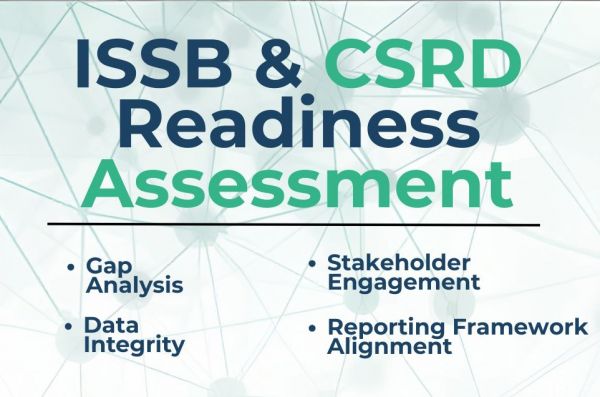
ISSB / CSRD Readiness Assessment

About The Service
Other Information
Customer Challenge
Sustainability reporting regulation has expanded significantly across the EU and internationally. CSRD extends mandatory sustainability disclosure to a large number of companies on a phased timeline. ISSB standards are being adopted across multiple jurisdictions. Yet most companies approaching their first reporting obligation have limited internal expertise, do not know which requirements specifically apply to them, and have never conducted a structured gap analysis against reporting standards.
The practical challenge goes beyond understanding the frameworks. Companies need to know: which ESRS data points are mandatory for our sector, what does double materiality mean in practice, which business units need to provide data, what governance structures are required, and what will this realistically cost and take to implement? Without a structured assessment, companies often either under-invest (discovering gaps at assurance time) or over-invest (building compliance infrastructure beyond what is required for their scope).
Regulatory changes, including the EU Omnibus package amendments announced in 2025, have also shifted timelines and scope thresholds in ways that require careful review of prior guidance.
Service Solution
Our project leads conduct a structured assessment across three phases: regulatory scoping to confirm which requirements apply and by when, current-state review to evaluate your existing reporting practices and data, and gap analysis to identify what needs to be built. The output is a written gap analysis report and a phased implementation roadmap that gives your internal team — or your chosen implementation partners — a clear brief for the work ahead.
We work with current regulatory texts and update our methodology for recent amendments. All assessments account for the latest ESRS standards, ISSB S1/S2, and applicable Omnibus adjustments where relevant to the client's scope.
Service Activities
Regulatory Scoping
- Determination of applicable requirements based on entity type, size, employee count, turnover, listing status, and jurisdiction
- Timeline confirmation including any applicable extensions or phase-in provisions
- Multi-entity mapping for group structures where relevant
Current-State Review
- Review of existing sustainability reports, disclosures, or ESG materials
- Assessment of current data sources, collection processes, and internal systems against reporting requirements
- Governance structure review — sustainability oversight, board-level accountability, and internal roles
Double-Materiality Assessment (CSRD clients)
- Facilitated identification of impact materiality and financial materiality topics per ESRS methodology
- Stakeholder perspective mapping
- Prioritisation of material topics for disclosure
Gap Analysis Report
- Structured mapping of compliance gaps across all applicable disclosure requirements
- Gap severity scoring (critical / moderate / informational)
- Data availability assessment per disclosure requirement
Implementation Roadmap
- Phased action plan with estimated timelines, resource requirements, and dependencies
- Quick wins identified separately from longer-term infrastructure builds
- Recommendations on team structure, technology, and external support needs
Expert Consultation
- Minimum one 90-minute session to review findings, answer team questions, and confirm priorities
Key Results
Regulatory Clarity: A confirmed understanding of which requirements apply and by when — not based on general frameworks, but your specific situation
Documented Gap Analysis: Written assessment of every material gap between your current state and required disclosures, scored by severity
Realistic Roadmap: A phased implementation plan based on actual effort required, not optimistic estimates
Internal Alignment: A shared understanding across finance, sustainability, legal, and operations of what the compliance programme requires
Credible Starting Point: Documentation that can be shared with auditors, assurance providers, or board members to initiate implementation planning
Customer Value
Avoid Costly Surprises: Identifying gaps during a structured assessment is significantly less disruptive than discovering them during assurance or audit
Informed Investment Decisions: Understanding the full scope of what compliance requires allows for realistic budget planning and vendor selection
Structured Brief for Implementation: The roadmap gives internal teams and external providers a clear starting point — reducing scope creep and rework
Regulatory Confidence: Work based on current regulatory texts, not prior guidance superseded by amendments
Modular Engagement: The assessment is a standalone deliverable. You decide whether to proceed with implementation independently or engage further support
Industries covered by service
Industry Coverage Information
Delivery Model
Delivery Setup
Client responsibilities
- Initial discovery call (60 min) — provide company overview, entity structure, size, and regulatory context
- Share existing sustainability materials — prior reports, data sets, internal policies, governance documents
- Provide basic entity data — employee count by entity, turnover by jurisdiction, listing status
- Identify internal stakeholders — sustainability, finance, legal, and operations contacts for data requests
- Stakeholder input for double-materiality (CSRD) — 2–4 internal participants for materiality facilitation
- Review and provide feedback on draft gap analysis — within agreed revision window
- Attend expert consultation session — at least one senior stakeholder should participate
Delivery Region Scope
Delivery Language
Service Outline
Mandatory sustainability reporting has moved from a voluntary best practice to a legal obligation for a growing number of companies. CSRD, enforced through European Sustainability Reporting Standards, applies on a phased timeline beginning with large listed companies and extending to non-listed large companies and smaller listed companies over subsequent years. ISSB standards are being adopted as the baseline for climate-related disclosures in an increasing number of jurisdictions globally.
The scope of these requirements is substantial. CSRD requires disclosure across environmental, social, and governance topics, with double-materiality assessments, assurance requirements, and data traceability standards that require new internal processes and systems for most first-time reporters. Understanding exactly what is required, in what form, and by when is the necessary starting point for any realistic compliance programme.
Our Approach
We work from current regulatory texts and your specific entity characteristics — not generic checklists. The assessment begins with a scoping call to confirm your regulatory situation, proceeds to a structured review of your current state, and produces a written gap analysis and roadmap. We incorporate the latest regulatory developments, including scope adjustments from EU Omnibus amendments, into our scoping methodology.
The double-materiality assessment component (for CSRD-scope clients) is facilitated with your team rather than imposed from the outside — ensuring the resulting material topics reflect your business reality, not a template list.
What's Included — All Packages
All engagements include:
- Lead regulatory specialist as primary contact
- Current-text regulatory scoping (not prior guidance)
- Written gap analysis report
- Expert consultation session(s)
- Email support throughout engagement
Available Add-Ons
- On-site double-materiality workshop facilitation — €2,800 + travel
- Assurance readiness review — €3,500 flat fee
- Additional entity scoping (beyond base scope) — €1,500 per entity
- Regulatory monitoring subscription (email-based, 12 months) — €1,800/year
Prerequisites for Successful Engagement
- Basic entity information available — employee count, turnover, listing status, jurisdictions
- Senior sponsor identified — someone with authority to make implementation decisions
- Existing sustainability materials accessible — any prior reports, data, or policies
- Internal stakeholders available — 2–4 people with knowledge of operations, finance, and HR
- Realistic timeline expectations — Discover requires 4–5 weeks minimum; timelines cannot be compressed without impact on quality
- Budget awareness — implementation of a full CSRD programme typically requires significant additional investment beyond this assessment; the roadmap will scope those requirements
Frequently Asked Questions
Q: We are not sure if we fall under CSRD — should we start with this service?
A: Yes. The Discover package begins with a regulatory scoping exercise designed precisely to answer this question. We confirm your obligations based on current regulatory text and your entity characteristics.
Q: How does the EU Omnibus package affect our CSRD obligations?
A: The 2025 Omnibus amendments proposed adjustments to scope thresholds and timelines for certain categories of companies. Our scoping methodology incorporates these amendments. We confirm the current regulatory position as of your engagement date.
Q: What data do we need to provide to start the engagement?**
A: Basic entity data (employee count, turnover, listing status), any existing sustainability materials, and access to 2–4 internal stakeholders. Full data collection requirements are confirmed after the discovery call.
Q: Does the service include implementation support?
A: The Discover and Realize packages are assessment services — they produce the documentation and roadmap for implementation. Implementation support is a separate engagement. The roadmap from Realize is designed to brief internal teams or external implementation partners clearly.
Q: How long does it take to implement CSRD once we have the roadmap?
A: Implementation timelines depend on your gaps, team capacity, and whether external support is engaged. Most first-time reporters require 12–24 months for full implementation before their reporting deadline. The roadmap will include a realistic timeline estimate for your specific situation.
Q: Can we complete this assessment and then implement internally?
A: Yes. The deliverables are designed to be usable by internal teams. Many clients use the Discover or Realize outputs to brief internal sustainability, finance, and legal teams, and proceed with implementation without further external support.
Getting Started
- Step 1: Contact us at sales@impactmaker.co or complete the regulatory readiness pre-proposal questionnaire
- Step 2: Discovery call (45 min) — confirm entity structure, regulatory position, and scope
- Step 3: Proposal delivery (3–5 business days) — confirmed scope, timeline, and investment
- Step 4: Kick-off within 1 week of contract signature
Impact Maker | www.impactmaker.co | sales@impactmaker.co
Regulatory scoping and gap analysis for organisations approaching CSRD and ISSB reporting obligations
Categories
Expertise
€6,450.00
Ideal For: Companies needing to understand their regulatory position and document gaps before committing to an implementation programme
- Discovery call (60 min) — regulatory scoping inputs, entity structure, existing materials review
€15,050.00
Ideal For: Companies that have established their regulatory position and are ready to plan a structured compliance programme
- Additional to DISCOVER Phase:
€24,940.00
Ideal For: Listed companies, large non-listed groups, and organisations with simultaneous CSRD and ISSB obligations
- Additional to Discovery & REALIZE, plus: